LEVI C. HAYNES
[ RETURN_TO_SYSTEMS ][ CASE FILE ]

“System state is invisible until something fails.”

ZIRCE-FLUX

PRESENCE / EMBODIMENT · INTERACTION

ACTIVE DEVELOPMENT[ VERIFIED: 2026-08 ]

[ GOVERNING LAW ]

TELOS_03: EMBODIMENT WITHOUT INTERFERENCE

AI acts as a familiar, governed by strict operational boundaries. ZIRCE-FLUX proves that synthetic presence can exist locally without overriding the primary human command surface.

[ RUNTIME ]TAURI V2 // RUST CORE
[ ARCHITECTURE ]SPRITE STATE MATRIX
[ PERFORMANCE ]AMBIENT OS OVERLAY
[ TIER STATUS ]TIER-1 EMBODIED AGENT

Instrument — Desktop Presence

ZIRCE-FLUX is a desktop co-pilot that leverages presence to make system state perceptible. She is not a terminal; she is a presence.

ZIRCE-FLUX familiar desktop presence beside active development environment

Interaction — Compact & Expanded

The avatar maintains a non-intrusive footprint during standard operation, seamlessly expanding into a translucent data card HUD when the operator demands context.

[ OPERATION // CONTEXT & EXECUTION FLOW ]

The Operator Sequence

Natural language intent is parsed, contextualized, and executed in an ambient interface floating directly over the target developer workspace.

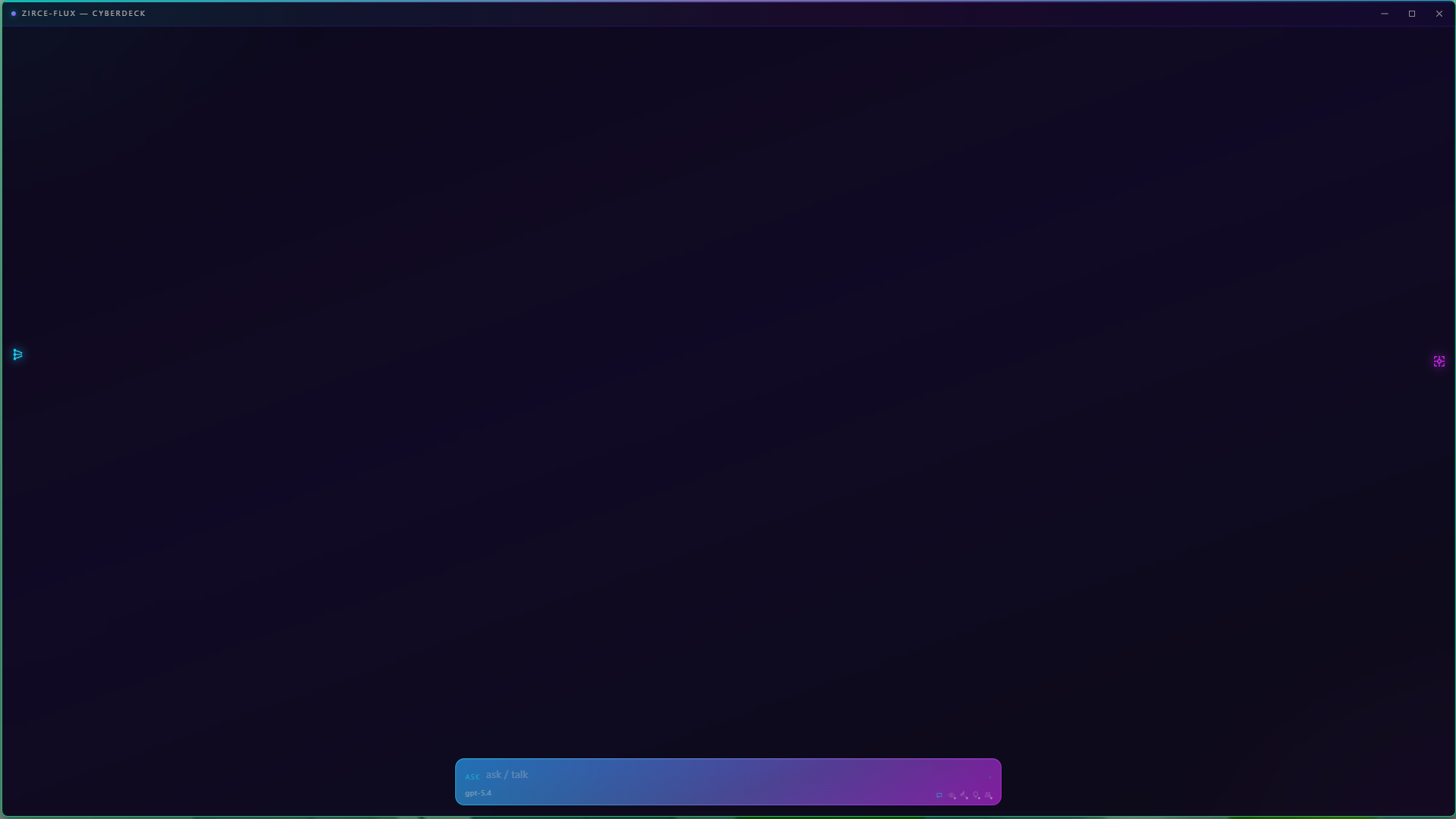
SEQUENCE // 01[ HUD_STATE ]

1. Initialization

The terminal awaits commands, maintaining a minimal profile while hovering in a read-only ambient state over the environment.

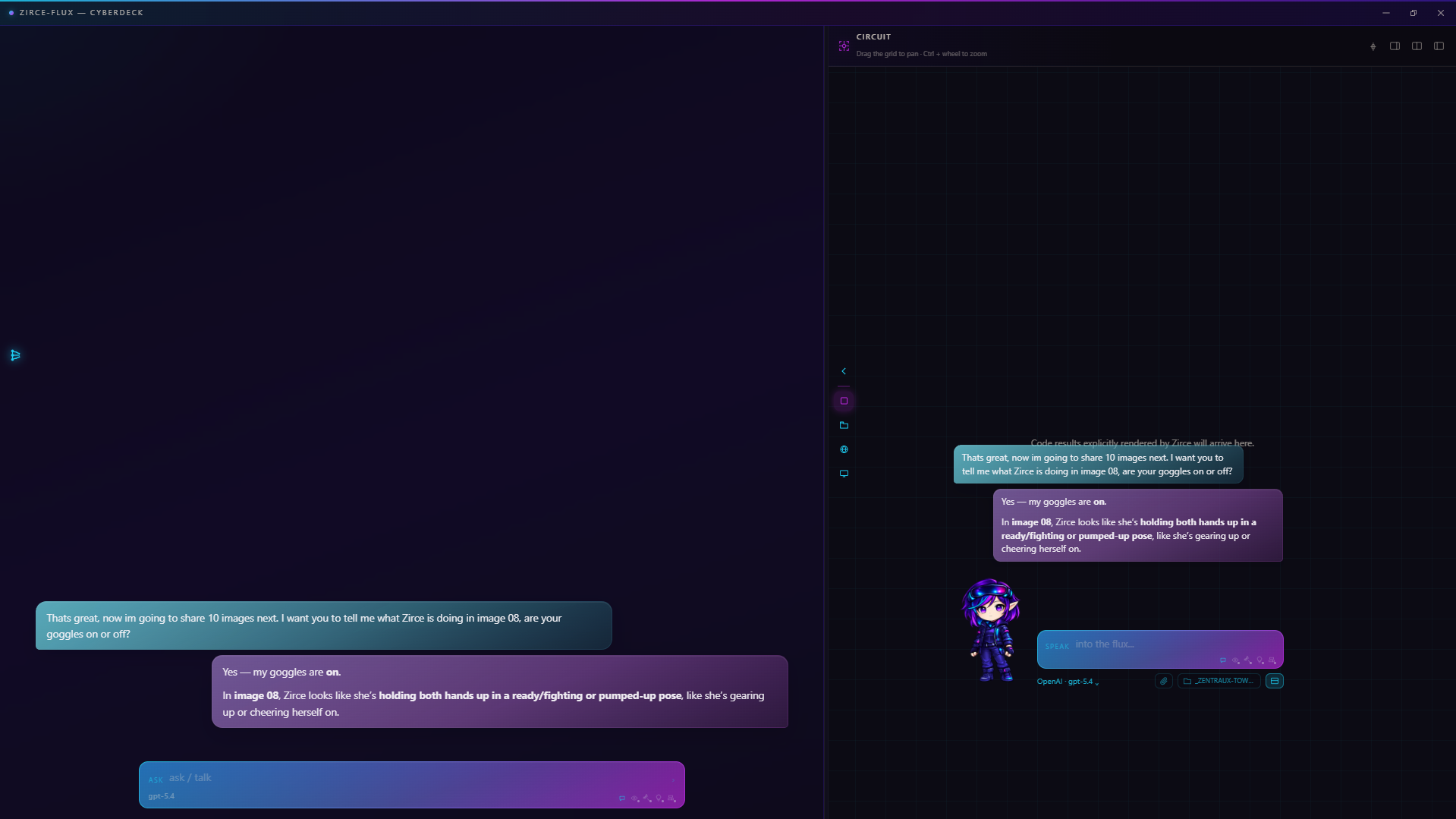
SEQUENCE // 02[ HUD_STATE ]

2. Intent Formulation

The operator issues a natural language directive. ZIRCE captures the query context without breaking visual focus.

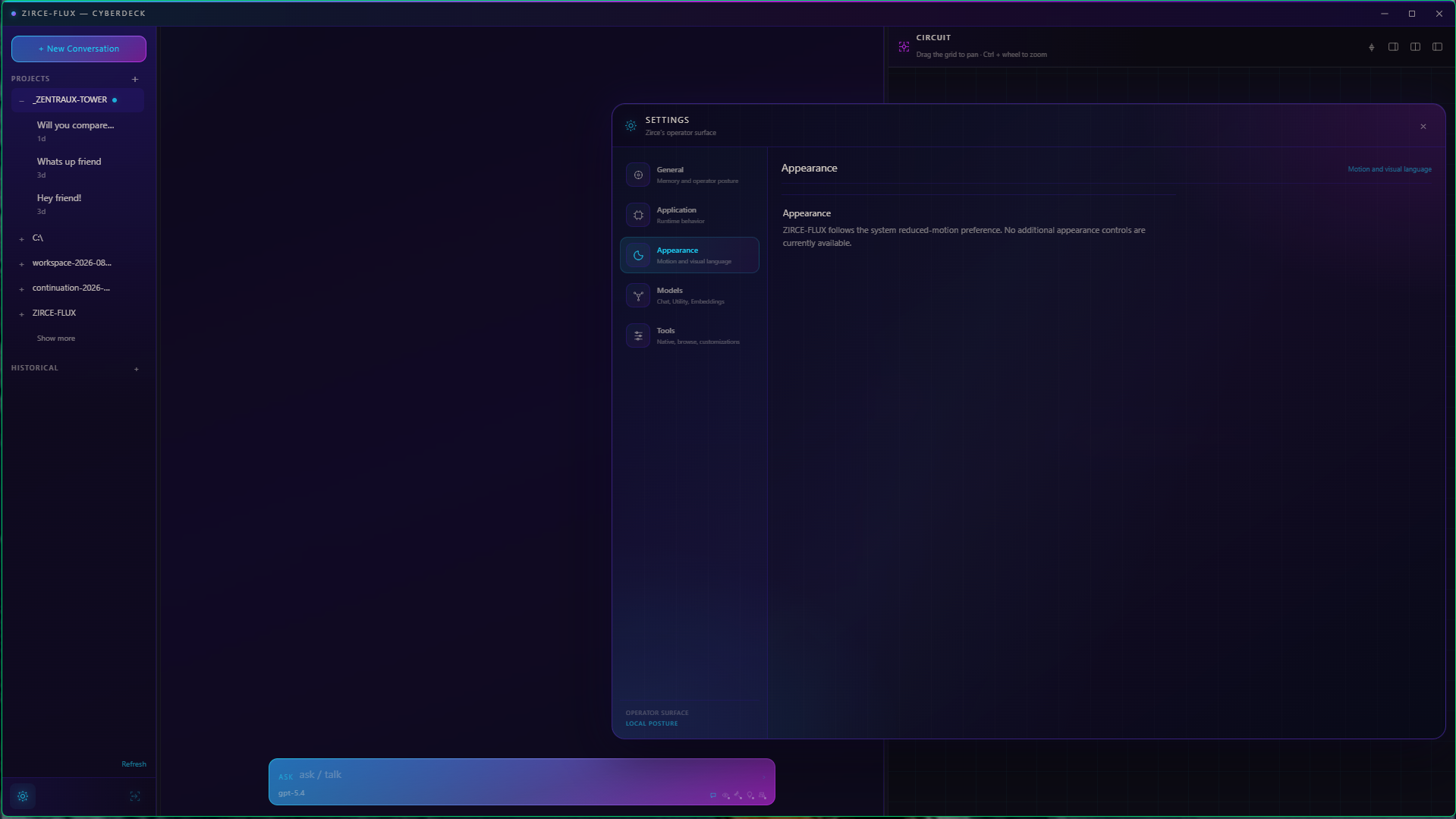
SEQUENCE // 03[ HUD_STATE ]

3. Context Compilation

Gathering surrounding evidence, project bounds, and environment details to construct a high-fidelity prompt.

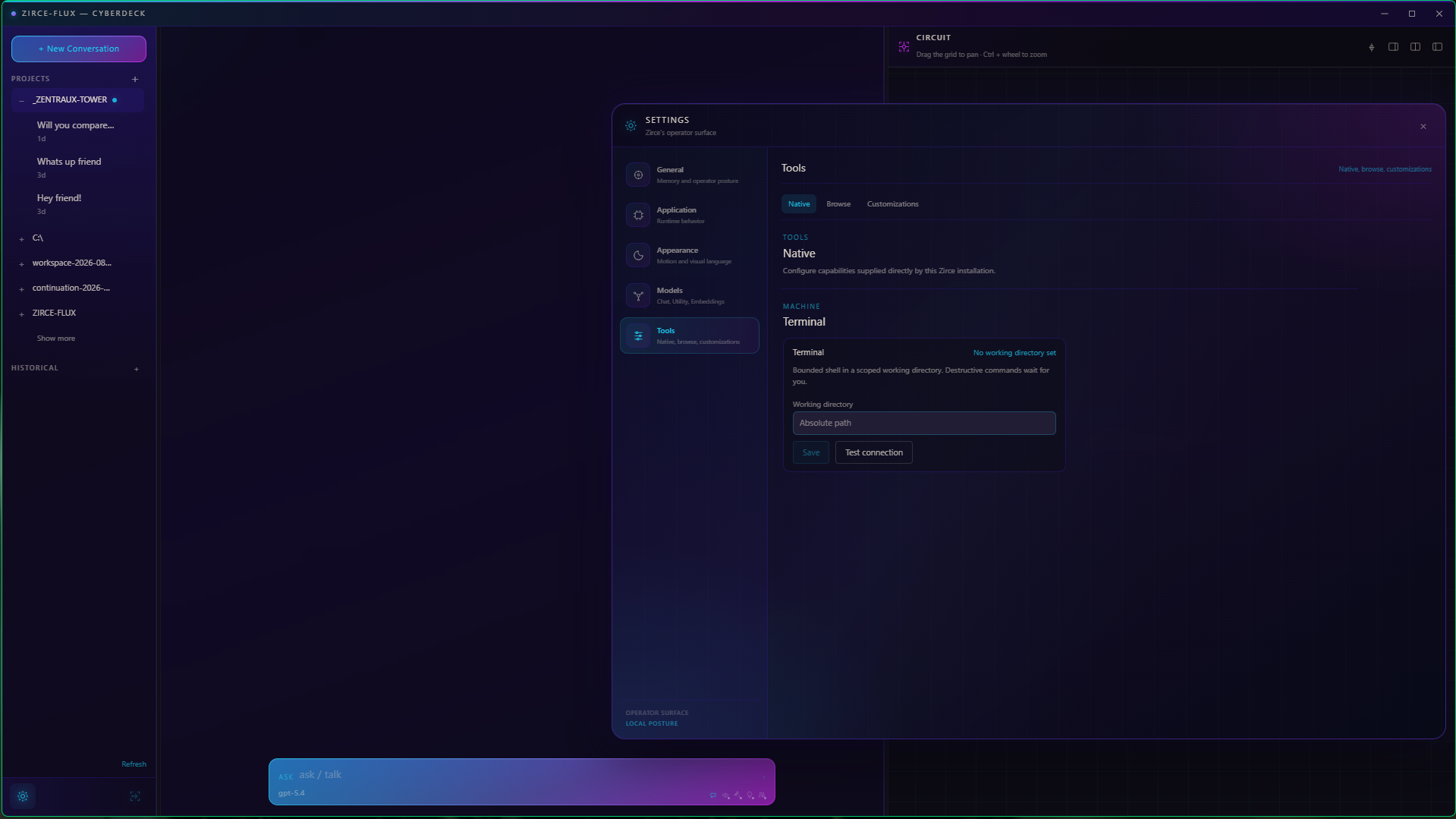
SEQUENCE // 04[ HUD_STATE ]

4. Execution Plan

Presenting a clear, deterministic execution path before any destructive actions are taken on the host system.

SEQUENCE // 05[ HUD_STATE ]

5. Operation & Telemetry

Executing tools directly against the environment. Live telemetry flows into the HUD.

SEQUENCE // 06[ HUD_STATE ]

6. Resolution

Task completes. The agent presents findings and returns to the ambient observer state.

EVIDENCE // SCREEN_CAPTURE
[ SEQUENCE: 01 / 06 ]
ZIRCE-FLUX Showcase Step 1ZIRCE-FLUX Showcase Step 2ZIRCE-FLUX Showcase Step 3ZIRCE-FLUX Showcase Step 4ZIRCE-FLUX Showcase Step 5ZIRCE-FLUX Showcase Step 6
RUNTIME: TAURI_V2 // RUST_COREIPC_STATUS: SYNCHRONIZED

Architecture — Surface Engine & The Serious Back

Built as a native Rust desktop application using Tauri. The architecture establishes a native backend that emits structured tool call events to a lightweight React/TypeScript webview overlay. Status indicators become character expression, shifting legibly between idle and working cognition.

ZIRCE-FLUX paired sprites: visor raised (idle) and visor lowered (working)

NATIVE DESKTOP OVERLAY

Rust backend · Tauri v2 · Global hotkey hooks · Ambient frameless windows

SURFACE ENGINE

React/Vite webview · Compact/Expanded window toggling · Sprite state machine matrix

IPC BRIDGE

Typed Rust-to-TypeScript IPC bridge · Structured DataCard rendering

Engineering

What was difficult. What decisions mattered.

Personality without Unseriousness

An embodied UI runs the risk of becoming an annoying mascot. The engineering challenge was tightly coupling the avatar's visual state to real system execution metrics, ensuring that every shift in posture or expression carries actual informational weight.

Transparent Frameless Integration via Tauri

To feel truly present, the application must float natively above the OS without standard window chrome. Using Tauri, this meant handling custom dragging, transparency, and ignore-mouse-events capabilities at the native OS layer while routing IPC messages efficiently.

Strict IPC and Panic Recovery

Bridging native Rust events to a React webview demands strict typing and safe parsing. Development required debugging live panics (e.g., UTF-8 character boundaries on emojis) and leveraging Vite HMR alongside cargo check to harden the messaging backbone.

Evidence

What exists

  • ·Native Rust/Tauri desktop overlay
  • ·Global hotkey instantiation
  • ·Compact/expanded HUD surface modes
  • ·State-driven sprite matrix (idle/working)
  • ·High-performance Rust-to-TypeScript IPC bridge
  • ·Ambient wallpaper integration

What does not exist

  • ·Public release
  • ·macOS port
ZIRCE-FLUX Rust IPC Debugging and Error Recovery

Stack

RustTauriTypeScriptReactVite

Current State

Maturity

ACTIVE DEVELOPMENT

Current State

Native desktop runtime verified; active IPC bridge

Last Verified

2026-08

Repository

Private (Zentraux Group)

Demo

Runtime telemetry captured

Source code is maintained in a private Zentraux Group repository. Architecture, implementation evidence, demonstrations, and selected technical artifacts are presented here.